Categories
Uncategorized

Opening Ceremony for The 60th iMEP Session : Athens Welcomes Europe’s Future Leaders

(CNN) – Athens, Greece, the birthplace of democracy, where the v60th International Model European Parliament (iMEP) session opened, bringing together delegates from a total of 32 countries. The city, filled with history and democratic tradition paired with the stunning and
historical opera house of Maria Callas, provided the perfect setting as Europe’s potential future young leaders gathered to open the 30th anniversary of the first ever iMEP session.

A Celebration of Unity and Tradition

The grand ceremony began with the national anthem of the European Union, followed by the Hellenic Republic, uniting the audience in a powerful display of cultural and political solidarity. Hosted by Mr. Alexis Kostalas, the ceremony featured the breathtaking performances by a youth choir from the Leonteios School Nea Smyrni, with soloists Mr.Charalampos Velissarios and Ms. Ada Athanassopoulou, highlighting just how important the session is.
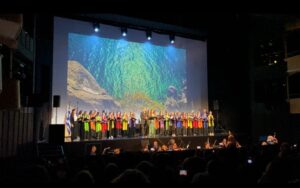

The Performance of Ms. Ada Athanassopoulou, Mr. Charalampos Velissarios, accompanied by the Orchestra and Choirmaster, Ms. Katerina Vassilikou and the Youth Choir of Leonteios School Nea Smyrni

“Young People Are the Changemakers” The second speaker, Mr. Ioannis Maniatis, encouraged the youth delegates to embrace their roles as potential future leaders. “Young people are not just the leaders of tomorrow; they are the changemakers of today,” he declared, emphasizing the importance of their involvement in shaping Europe’s future. His words set the tone for a session focused on collaboration and growth.

Honoring the Greek Traditions with the Great Kostis Palamas

Kostis Palamas, a monumental figure in Greek culture and the father of modern Greek poetry, was celebrated during the ceremony for his profound impact on democracy and national identity. His significance was highlighted through the world premiere of five previously unreleased poems, generously donated to the iMEP. Palamas’ legacy, deeply rooted in Greece’s cultural heritage, served as an inspiring reminder of the values that continue to shape Europe today.

Foundations of a Complete Education

During the session, the Greek word for education, “Παιδεία,” washighlighted for its deep roots in ancient Greek culture, by the president of the session Mr. Paris Tsoumanis, symbolizing the lifelong process of shaping a person into a social being. Paired with “Μόρφωση,” which refers to formal schooling, these concepts together represent the holistic development of a human, blending life experience and academic learning to prepare individuals for their role in society.
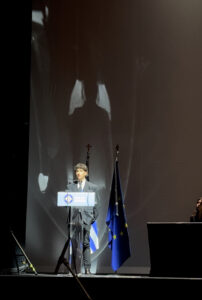
Mr. President Paris Tsoumanis holding his speech about the mythical yet intense meaning of two Greek words.

Collaboration: The Heart of Europe’s Strength

Mr. Gottfried Oehl, Chairman of MEP Europe, delivered a powerful speech on the importance of unity in Europe. He thanked the host families and embassies for their support and highlighted Europe’s achievements, comparing them to the 62 Olympic gold medals Greece has won. “A better Europe can only be made with collaboration,” Oehl stated, emphasizing that Europe’s greatness lies in its ability to work together.

Voices of a United Europe: Powerful Words from 32 Nations

In a moving display of unity and pride, the heads of delegation from each of the 32countries delivered speeches representing thenations. Each delegate spoke passionately, bringing to life the unique challenges, hopes, and visions of their people. From heartfelt
reflections on history to bold calls for collaboration, the speeches were a testament to the rich diversity and shared aspirations that define Europe.

Inspiring the Next Generation

The ceremony was closed and completed with a touching message from Madam Chair Esther Papanikolaou, who gave an extremely empowering and inspiring pep talk, addressing each and every member of the audience. She concluded the ceremony by explaining the exceedingly crucial concept of teamwork and collaboration,expressing her trust in each
delegate to have the potential to grow and bloom in the EuropeanUnion and its parliament

Mila Jalasto CNN

Categories
Uncategorized

Tech Monopolies: To be or Not To Be?

In a world where those in power hunger for more, the European Union has decided that the tech superpowers have had enough, and they must be limited before they can gain too much of a hold over the consumer, but is it too late? Is there truly anything that can be done now? Furthermore, is it a worthy cause? Must we focus on taking the power from the already powerful when people continue to go hungry, when wars wage, when some can’t keep the lights on? Are tech monopolies truly relevant to a world in turmoil?
What must first be understood is not whether it is necessary to change but whether it is possible to change. How can one restrict a tech monopoly when it already lays claim over the population? In an interview, Famke Jongstra claimed that there are lots of routes that can be used to ‘minimalize the influence tech monopolies have’. In her workplace, the Committee on Internal Market and Consumer Production, there is work towards protecting the consumers and small companies from tech monopolies, and Jongstra believes that “they’ve come up with a great number of good ideas”.
The reference to ‘a great number of good ideas’ brings hope to the possibility of combating big tech companies, however, it must be brought to light whether there is a legal route, for the idea is at risk of breeching free market law. This law simply suggests that the market responds to supply and demand with little to no government intervention. By implementing restrictions, the government therefore is involved and breaking the concept of the free market. Jongstra, when addressing this, admitted “it’s a very complicated issue, and something we struggle with a lot but we look at every rule we have and try to work around it or find loopholes so we can still implement our (ideas)” This suggests that, not only is the free market not entirely free, but governments are capable of restricting them, if the need comes to pass.
However, even if these restrictions were to be put in place, who can ensure that they would be effective? In a society where tech companies hold the most power in the market, with a history of unethical and not entirely legal practices, can we be ensured that they would follow such regulations? Can we be ensured that the regulations would affect them? Jongstra rightfully observed that “it’s always difficult to know that beforehand, but I think because we are changing legislation on the way that these tech monopolies can behave in the European Union that it will be much more difficult to form a tech monopoly and of course we can’t forbid monopoly, but we can have a lot of influence”. On the delegate’s word we can only hope that this influence is strong enough to regulate a power that seems only to be growing.
On another note, would regulating these tech monopolies even affect the consumer, let alone positively? For, if there is no affect, it is worthless to put the effort and energy into this restriction. According to Jongstra, to restrict the power of the tech monopolies would be to give wider choice and more control into the hands of the consumer. Furthermore, this tech will constantly impact the consumer as their lives revolve around it, and it around them. On the other hand, many consumers may argue they feel no need to change their form of consumption, that this monopoly is more practical because there is no internal debate over this technology. Similarly, many may not want this change simply because they are accustomed to it.
Finally, we must question whether, in a time of political turmoil, should our government truly be focussing on the power in tech. Is it relevant to a world in which suffering is constant, not at the hand of power-hungry tech giants, but power-hungry governments and disregarded poverty and pain. Jongstra addressed this question, referencing an early answer: “yes, (it is necessary) because tech monopolies have such a big impact as the average EU citizen, from day to day, is in contact with this technology every moment of their lives.” This suggests that the priority is the masses, the many who interact with technology constantly, and though we do address the suffering, we must also address the issues that all face, to make a fully functional and fair society.
Overall, tech monopolies dominate the lives of the population and cannot be allowed to do so anymore as they threaten the freedom of choice of the consumer while enforcing an impact upon them. Therefore, it must be considered that if it is possible to regulate tech monopolies (as has been previously argued) that they must be regulated

Salma Nassar – EUobserver

Categories
Uncategorized

Severe floods and wildfires in the European Union have severe consequences

As years go by, Europe is increasingly facing severe wildfires, floods and many other natural disasters resulting in significant causes many losses, such as economic ones.

Today, the committee ENVI discussed this important matter, researching it from various perspectives and searching for a way to make the impact of these natural disasters as little as possible.

One of the countries trying to find a way to do the former, is the Netherlands. Although the delegate of Netherlands doesn’t feel the impact of the disasters as much as others, they do find it important to contribute their opinions to the meeting to find the perfect solutions for this life-threatening problem.

According to the delegate, climate change isn’t the only thing that leads to natural disasters. They stated that nature itself is another aspect at the source of, for example, the floods. If there are obstacles in a river, it will flood quickly. The river’s capacity would reach a maximum, thanks to the rain, and the river would flood. Damage would be done to nearby houses, and they would need to move.

The floods can also release pollutants stored in the ground and spread them even more widely, they may also destroy wetland areas and reduce biodiversity. This may also bring economic losses that we have to deal with. However, the delegate mentioned that it’s a very difficult problem to solve on the European level. He doubts that giving funds to the companies would be efficient, because the EU will never reach all of the small businesses and the people in general. Therefore, he believes that this problem should be solved on a more local level.

The only way to prevent floods is to reduce the frequency of them happening. Therefore, this delegate wants to prevent climate change from developing further, by making sure that every country is doing the best they possibly can.

They stated that we must adapt to living with climate change, which means that we must learn to live with nature and not beaggressive against it by simply ignoring it or saying that nothing has happened.

Having to adapt to climate change also includes the farming market. Due to the floods, the soil become infertile, and we will be unable to grow any crops on it. As a possible solution, the Netherlands suggested that we move the farming lands to another place in the European Union that still has fertile soil and that can still produce the right amount of food for everyone. They stated that we help each other and form strong relationships between European countries, so that every citizen has the food they deserve.

Next to floods, wildfires are also a prominent issue that is being taken care of by this committee. We asked the delegate of the Netherlands what he had to add to this statement.

‘The wildfires are a grand problem in some countries’, stated the delegate. It really is a problem, not as much in the Netherlands, but in other countries like Greece.

The delegate proposed various solutions like planting more trees. They stated that planting trees sounds weird at first, but doing it reduces the temperature of the surroundings and increases the humidity, which eventually leads to less wildfires. A negative aspect of planting trees is that it takes a lot of time, sometimes even time that we won’t possess.

Because a case like wildfire is a danger to all civilians, they should be educated about what to do in case of emergency.

Conclusion:

Today, a delegate from ENVI talked about floods and wildfires. They talked about some problems and made several propositions on how to solve their specific question.

Myrre De Nies , Reuters


Categories
Uncategorized

Moving backwards: The rise of Authoritarianism in Europe

Europe is on the verge of a political revolution.

All across the continent, far right and nationalist parties are topping the polls in regional, national and even international elections. In states such as France (the National Front), Sweden (Swedish Democrats) and Finland (The Finns) to name a few, the far right party has become the most popular group. Even countries such as Italy, Spain and Germany – all of which have all been incredibly sensitive of their fascist pasts – have allowed these extremist organisations to proliferate and gain large followings.

The European elections were also held last June, and recorded results that haven’t been seen since the Second World War. The far right parties such as the European Conservatives and Reformists (ECR) and Identity and Democracy (ID) won 131 seats, a substantial increase over the previous elections. These results have given the far right a foothold into the European Parliament. This will allow them to spread their ideas easier, and will allow them to generalise and possibly create radical legislature that could damage the already set out plans of the EU.

Why is this happening? Why are millions of voters swaying from the traditional leftist majority in the EU? And what effect will this sudden switch of voters have on minorities in the European Union?

I interviewed a delegate of the LIBE JURI committee to answer this question. Beforehand, I outlined three major causes of this sudden skyrocketing of voters.

Issues linked to identity – Many countries in the EU feel as if they are losing their culture. They have looked to these far right parties (who promise to in most cases restrict border access) for a way to conserve their national heritage.

Economics – Many Europeans are against the idea of mass immigration and globalisation, because they believe it is taking the money and jobs away from their country. The far right use this to their advantage to stir outrage against minority populations, and gain traction from those wanting to keep the money where it is made.

Social justice – Finally, many Europeans feel as if they are not in control of the rules that govern their countries. The opinion is that the EU creates laws that do not line up with the majority. The far right provide a vessel to help change these laws.

We also discussed the effect far right governments will have on minority groups such as racial, ethnic and religious groups, as well as LBGTQ+ people. The delegate described the way that far right governments can vilify and use these minorities as scapegoats to blame their problems on. They argued that due to these false claims, the access that minority groups have to services like healthcare and education is greatly hindered.

This can very easily led to the creation of a poverty cycle. When minority groups are denied basic necessities, they are pushed into lower paid jobs and sometimes straight into poverty. This is a cycle that is very difficult to escape, leading to stereotypes and assumptions of any immigrants coming into a country to be negative.

Whether intentional or not, this is the world that the rise of authoritarianism in Europe can create. The BBC is dedicated to providing information of the upmost quality regarding issues like this

Tom Egan BBC

Categories
Uncategorized

European Union-US Relations: Navigating Future Scenarios

In recent years, the transatlantic relationship between the European Union (EU) and the United States has been characterized as “beneficial, but lopsided” by one of the delegates from the Committee on Foreign Affairs. This phrase encapsulates the dynamic where the US wields significant influence, particularly through its military might, while the EU plays a supportive role in global affairs.

Looking ahead, the future of EU-US relations could take different paths depending on the outcome of the upcoming US presidential elections. Should Kamala Harris secure victory, continuity with the Biden administration’s policies is expected, meaning potential reductions in monetary aid to countries like Ukraine. In contrast, a return of a Republican leadership, represented by figures like former President Trump, could mean an increase in protectionist measures. This scenario might include universal taxes impacting EU imports and heightened tariffs on goods from China, altering trade dynamics significantly.

Among these potential shifts, the question arises: can the EU assert leadership in this partnership? Despite the EU’s economic prowess and diplomatic efforts, its influence remains constrained by the overwhelming military power of the United States. As the delegate notes, “I do not see a future in which the European Union leads the relationship,” underlining the enduring dominance of US hard power.

However, amidst this disparity, soft power emerges as a critical tool for the EU to wield influence. Soft power, defined as the ability to shape preferences through attraction rather than coercion, offers avenues for the EU to strengthen its global standing. By emphasizing shared values, promoting cultural exchange, and championing multilateralism, the EU can bolster its international influence. Strategic investments in education, humanitarian aid, and sustainable development projects can further enhance the EU’s soft power appeal.

To sum up, while the EU-US relationship remains inherently imbalanced, the strategic deployment of soft power presents opportunities for the EU to carve out a more assertive role on the global stage. As the world navigates evolving geopolitical landscapes, harnessing soft power could prove pivotal in shaping cooperative and mutually beneficial EU-US relations.

Victoria María Velasco Artacho, Euractiv

Categories
Uncategorized

Euronews’s Second Day of MEP Committee Meeting: CULT By: Dayeon Woo

Listening to the wonderful performances by Mr. Charalampos Velissarios and Mrs. Ada Athanassopoulou, the delegates started their day. The delegates were able to learn more about each others’ countries as the heads of delegations delivered their presentation speeches about their countries.

Today, we have closely observed the committee meeting of the CULT—committee on Culture and Education. Its committee issue focused on the importance of improving the education quality across the EU member states while supporting already-existing blueprints. The issues also directed the attention of the delegates to the European Degree: a blueprint for the creation of an optional universal degree all across the EU member states for higher education in the universities.

The meeting was filled with enthusiasm: every delegate was eager to voice their opinions. They were able to speak up for their thoughts in polite and positive manners, brightening the mood of the meeting. During the meeting, many valid points were brought up to attention. The delegate of Italy underscored the importance of acknowledging the differences across the EU member states’ education systems. Furthermore, the variances in admission requirements and entrance exams in different countries were also talked about. These factors helped the delegates of CULT to brainstorm about various determinants that would hinder the enhancement of education in the EU countries. Not only that, the delegates redirected their focus on the matter of ensuring equal rights for education for all people. The delegates mentioned the disadvantages the physically or intellectually disabled might have to go through during the process. We think that the general issue of the CULT committee mainly focused on the issue of disparity between countries or social classes.

We interviewed the Finland delegate Kaius Kauppila to enrich our current understanding of the CULT’s situation. Kairus explained the need for transnational cooperation between countries: he stated that cooperating across nations will further help boost the EU’s competitiveness as a whole. By working together, the EU will be able to gather experts all across the continent of Europe, and, by doing so, this will help the countries share their expertise on the field of education. The idea of European Degrees seemed to be very appealing to most of the EU countries. It was a new form of qualification that the EU students could use universally across the EU member states. We thank Kaius Kauppila for gladly accepting our interview request as we were able to learn so much from him.

The delegates are getting ready to finish the introductory clauses by tomorrow, and we hope to inform you more about tomorrow’s meeting as every committee starts to wrap up their sessions.

Categories
Uncategorized

Building Bridges: The EU’s Strategic Push for International Demand and Youth Housing

The European Union is facing numerous challenges, particularly in promoting economic growth and competitiveness. A recent discussion within the Committee on Civil Liberties, Justice, and Home Affairs (LIBE) has centered on supporting EU governments in implementing policies to create international demand for European products and services.

A delegate from Luxembourg and member of the LIBE committee, shared his insights on how the EU can better support member states in this area. Tools that use geographic data to inform economic decision-making, are seen as a key tool in understanding and fostering international demand. The delegate  emphasized that governments need support in implementing these tools to expand the reach of products and services not only within the EU but globally.

A core issue identified by him and his colleagues is the development of product solutions that cater to the international market. One of the main challenges is the fragmentation of national policies, which makes it difficult to craft coherent EU-wide strategies. The lack of alignment between national and EU policies hampers efforts to promote global demand for European products. By developing policies, the LIBE Committee hopes to create a harmonized framework that helps governments address these gaps.

Furthermore, the delegate explained that the policies must have real-world applications and clear timelines. To make a tangible impact, policies should go beyond theory, focusing on implementation that aligns with current market conditions. He cited examples of existing programs aimed at building international demand, stressing the importance of scaling these efforts across member states.

Another issue that arose during the discussion was the housing crisis faced by young Europeans. The delegate highlighted the similarities between the need to promote international demand and the challenge of helping young people enter the housing market. With rising property prices and limited access to financing, many young Europeans struggle to afford their first home. He also  argued that potential purchases at the high end of the housing market should be limited to make homeownership more accessible to first-time buyers.

In conclusion, the future depends on the ability to develop coherent, spatially aware policies that address both economic and social concerns. The LIBE Committee’s focus on fostering global competitiveness and supporting young people in the housing market will play a critical role in shaping the EU’s future.

Emilia Saastamoinen, Politico

Categories
Uncategorized

A transnational university degree – the latest agenda item to unify Europe?

The  Model European Parliament has once again put its foot on the gas, first day of working is over and the several committes have already started brainstorming about IC’s for a resolution. So did the CULT committee (the Committee on Culture and Education). It’s the 60th time of an iMEP and this time, it takes place in Athens. The CULT committee has a topic, which affects especially us, the young generation. How can European students get the highest possible quality of education in the EU? This is the committee topic. It is all the more important that the CULT Committee faces this challenge and works on constructive solutions. But to work together and not against each other, a relaxed and respectful way of working is needed.

What is it like working in CULT?

According to reports from the CULT Committee’s first day, delegates are already engaging in heated debates, while it is important, everybody has an own opinion. Further the delegate from Austria mentioned he is striking that there will be a good resolution. The 12 delegates from CULT made out the first IC’S and noticed a few disparities between the members of the EU when talking about the topic. Even though the committee mostly agrees to one another, first deep discussions have happened.

The Push for a “Uniform” University Degree – necessary?

The EU’s latest project, a transnational university degree, is yet another attempt to flatten Europe’s rich diversity under the banner of “cooperation.” Can we actually impose the rest of Europe with this model? In fact the delegate from Austria believes that this collaboration has immense potential in boosting Europe’s competitiveness. He thinks this collaboration guarantees our future generations very “important skills”. Contributing to this, he is of the opinion that there are indeed some subjects missing in todays schoolsystem. In Austria, the delegate bemoans the lack of political education in the school system, which is significant for him. It is only sometimes and rarely integrated in subjects like geography. For example, in Germany the subject of politics comes very late and even then slightly in the 10th grade, but at least as a separate subject.

These differences show what the committee is very worried about and why it is according to them, of great relevance the EU gets a uniform university degree.

Vincent Fleischhauer, Fox News

Categories
Uncategorized

Resurgence of Euroscepticism: A Challenge Amidst Radical Political Shifts

In recent years, Europe has witnessed a notable resurgence in Eurosceptic sentiments, largely powered by the rise of radical political parties across the continent. These parties, often advocating for nationalist and anti-establishment agendas, have tapped into widespread disillusionment with the European Union (EU). As the delegate of the Constitutional Affairs Committee pointed out, “it’s both the inability for the European Union to be effective, and some bad things happening in member states which have caused this phenomenon.”

The connection between the rise of radical political parties and Euroscepticism is evident. Citizens disillusioned with the EU perceive it as a slow and bureaucratic entity, distant from democratic ideals. The European Commission, primarily appointed by national leaders rather than directly elected, exemplifies the disconnect between Brussels and the European populace. Consequently, European elections have increasingly become battlegrounds where anti-establishment views find fertile ground, undermining traditional political structures.

This political landscape raises concerns about the future of European integration. Could we see the emergence of more leaders who leverage national interests against EU policies? The delegate stated that “this could cause another Orban to appear,” potentially flourishing significant influence over European decision-making.

Addressing these challenges requires a reevaluation of the EU’s accession criteria. Stricter entry requirements could mitigate the risk of admitting states unprepared for democratic norms and European values. For instance, the accession of countries like Serbia, with lingering autocratic tendencies, threatens to destabilize the Union from within. Such scenarios could empower leaders to obstruct EU initiatives, to Orbán’s political manipulation tactics.

Furthermore, the implications extend beyond internal governance. The image of the EU on the global stage could suffer if internal disputes persist. A fragmented Europe, divided by differing visions of integration, diminishes its collective influence in global geopolitics. As the delegate contends, “the dissolution of the European parliament and European Union would also make the effect of Europe as a whole on the global geopolitical stage much weaker.”

In conclusion, while Euroscepticism thrives amidst political upheaval, the EU faces a pivotal moment. Strengthening integration processes and addressing internal governance issues are critical to preserving its unity and global influence. Failure to do so risks encouraging further radicalization and eroding the Union’s standing in an increasingly complex world.

Victoria María Velasco Artacho, Euractiv

Categories
Uncategorized

Where have all our houses gone?

Rising house prices in Europe have become a significant concern over the past decade. Across the EU, housing prices have risen 2.9% on average, reaching as high as 17% in some countries. This issue has become prevalent to the MEP and has been placed under the remit of the LIBE committee.

The BBC interviewed a delegate to get a look into the state of the debate.

The delegate was asked about the state of their committee room, the sides being made, and the issues being brought to the table. The delegate described the rift that had been created within the committee regarding the effect of immigration on rising house prices. Furthermore, the delegate stated how voting blocs have been made regarding the issue.

Later, the delegate was questioned on how the EU might help decrease housing prices, more specifically regarding younger people in urban areas. The delegate responded that they hope to address this by increasing student accommodation near educational zones, with potential scholarships provided by schools, supported by the EU’s Shape EU fund. Additionally, they mentioned the plan to increase the minimum wage for students to help them afford rent and mortgages.

Concerning rising house prices fueling tension in Europe and what the EU could do to combat this, the delegate believed the biggest step would be combating monopolies, proposing that companies owning over €500 million in housing assets should be restricted. They emphasized the need to prevent artificial price manipulation for profit, calling it unfair to middle- and lower-class citizens.

Moreover, since foreign investments driving house prices up, the delegate explained that while the EU should allow foreign companies to continue buying houses, they should be required to rent them out or put them back on the market, rather than holding them to increase their value. They also advocated for increasing taxes on houses that remained vacant for over six months.

Finally, we debated whether housing prices should take priority over market regulation. The delegate argued that market regulation could address the housing crisis but stressed that shelter was a fundamental human right, one the EU has failed to deliver adequately so far. They hoped the LIBE Committee would ensure this right for all EU citizens.

Tom Egan, BBC